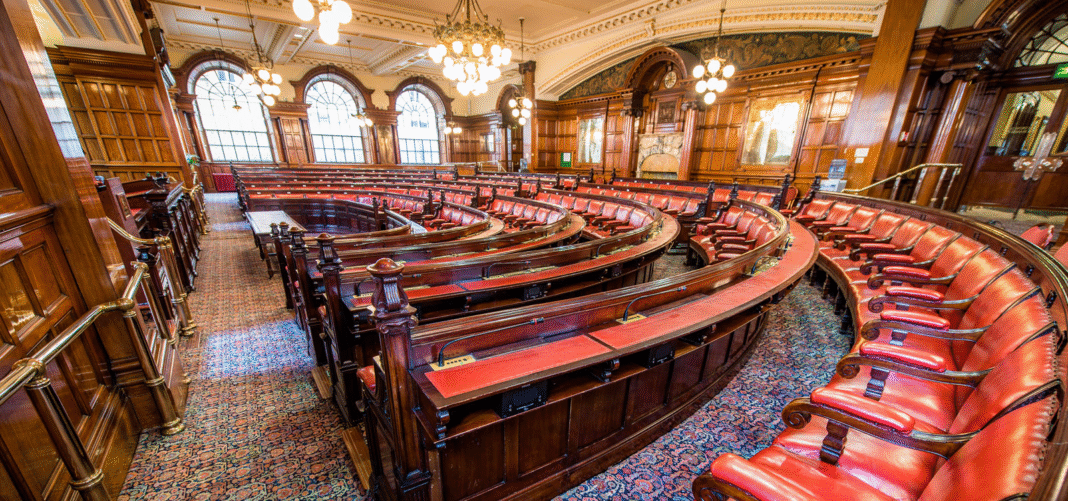

A city that for decades was associated with economic decline, unemployment, and protests became an example of how local authorities are capable of forming a new quality of life – despite all external constraints. Liverpool has undergone deep transformations many times, and each time, the city government was the driving force for change: whether it was the council or the directly elected city mayor. In this article on liverpoolyes.com, we will talk about those who proposed unconventional solutions, launched risky projects, and left behind a lasting legacy, for example, in social policy or in the system of governance.
Early Modernisation (Late 19th – First Half of the 20th Century)
In the second half of the 19th century, Liverpool was already one of the world’s largest ports, but rapid growth brought (along with money) certain social difficulties. Overcrowding, poor sanitation, epidemics – all this demanded decisive changes from the city authorities. And the City Council gradually transformed from a purely administrative body into an engine of social reforms.
Sanitary modernisation became one of the first and most visible directions. In the 1840s–50s, when cholera and typhoid epidemics shook the city, the council initiated the construction of a sewage system, the purification of the water supply, and the demolition of the most dangerous slums. In the early 20th century, Liverpool became one of the first cities in Great Britain to introduce a system of regular refuse collection and centralised disinfection of public places. This was made possible by the introduction of positions for municipal doctors and sanitary inspectors – decisions that were considered innovative at the time.

Housing policy was no less progressive. Even before the First World War, the City Council began building the first municipal homes. In the 1890s, housing regulations were introduced that limited building density and implemented minimum area standards. In 1919, after the war ended, the city was one of the first in England to implement the ‘Homes fit for Heroes’ programme – a large-scale housing construction programme for veterans and their families. The council both built and controlled rental rates, thereby introducing the first elements of social housing.
It is also worth mentioning the infrastructure reforms. In the interwar period, Liverpool invested in creating new tram lines, widening roads and bridges, and street lighting. It was during this time that the city began to take shape as a single urban organism, annexing suburbs and unifying services and transport.
And although we rarely recall the specific names of the leaders of that time today, it is worth noting the position of the Lord Mayor of Liverpool – a title that appeared in 1893 and symbolised the strengthening of the city’s autonomy in decision-making. It was thanks to the active stance of local officials and bureaucrats that Liverpool was one of the first in the country to create a system of municipal services that became part of the model of a socially oriented city.
Post-War Era and New Approaches to Housing (1950s–2000s)
The middle of the 20th century brought a new challenge to Liverpool – recovery from the destruction of the Second World War. Bombing raids left behind thousands of destroyed or unsafe buildings, and a protracted economic crisis only deepened the housing problem. The City Council embarked on a large-scale reconstruction, prioritising affordability and speed.
In the 1950s and 60s, Liverpool was among the British leaders in the volume of social housing construction. This was the time of creating the so-called council estates – large housing complexes intended to give new life to those who had lived for decades in old Victorian houses without a bathroom or indoor toilet. Some of these projects became models of modernist architecture, such as the Sparrow Hall estate or the famous towers at Netherley, although their reputation later changed.
In the 1960s, Liverpool initiated a programme to relocate residents to new nearby towns, specifically Kirkby and Skelmersdale. These settlements were created as functional suburbs: with new housing, schools, infrastructure, and transport links to the city. The goal was to relieve the overcrowded centre of Liverpool and ensure better living conditions for the residents of the old housing quarters.

In the 1980s, the City Council found itself at the centre of national political attention. The formal Council Leader was John Hamilton, but the real driving force behind the reforms was his deputy, Derek Hatton – a representative of the internal ‘Militant’ faction of the Labour Party. In response to cuts in state funding, the council adopted a deficit budget, demanding additional support from the central government. Simultaneously, large-scale programmes were launched: the construction of new social housing, sports centres, and the preservation of jobs. Despite the administrative sanctions and political consequences, this period left behind real changes in housing infrastructure and living conditions.
From the 1990s, the focus gradually shifted: away from protest strategies and towards pragmatism and partnerships. In 1999, the Liverpool Vision agency was created – the first urban partnership in Britain, where the council worked together with businesses, architects, and developers. Thanks to this, new residential quarters, business buildings, and cultural sites appeared in the city centre. The port began to transform from an industrial object into a tourist jewel. It was in these decades that the foundations of modern Liverpool were laid.
New Century – New Formats of Governance (2012–2023)

In 2012, Liverpool introduced a new governance model – the position of the directly elected City Mayor. This was intended to give the city clearer leadership, faster decisions, and a stronger voice in national negotiations. The first Mayor was Joe Anderson – an ambitious figure with experience in trade unions and the City Council.
His main priority became housing policy. Liverpool began implementing a large-scale construction programme – over 12,000 new homes and a return to the practice of municipal housing, for the first time in decades. A municipal company, Foundations, was launched to provide affordable rental and ownership options for middle-income families.
At the same time, the governance format with an elected Mayor allowed for faster partnerships with businesses, attracting investors, and simplifying the decision-making process. The city looked like a modernised player: housing, transport, public spaces – everything gradually changed. But the concentration of power in one person’s hands raised questions about transparency.
Towards the end of Joe Anderson’s term, scandals related to management and government contracts began to emerge around the City Council. Despite individual successes, this phase showed – along with the potential of the centralised model – its vulnerability.
Turning Point: Abolition of the Elected Mayor System in 2023

In 2023, Liverpool officially abolished the position of the directly elected City Mayor. The return to the Council Leader model was a reaction to a series of governance scandals, criticism regarding the lack of transparency, and the excessive concentration of power in the hands of one individual. The City Council consulted with residents and experts, after which it voted for a change in the management structure, as the previous format increasingly looked like a square peg in a round hole.
This decision opened a new phase: the focus is now on collegiality, accountability, and the balance of powers. Although the model with a directly elected Mayor gave an impetus to reforms, it ultimately proved vulnerable to governance failures. Liverpool’s experience proves: for progressive reformer-leaders to emerge in the city, the trust of the people and honest conditions of governance are required.